Listen Together or Fret Alone
As a mother of three, I fret all the time about threats over which I have no control: everything from school shooters to microplastics, flash floods to bullying. But I frequently fret alone.
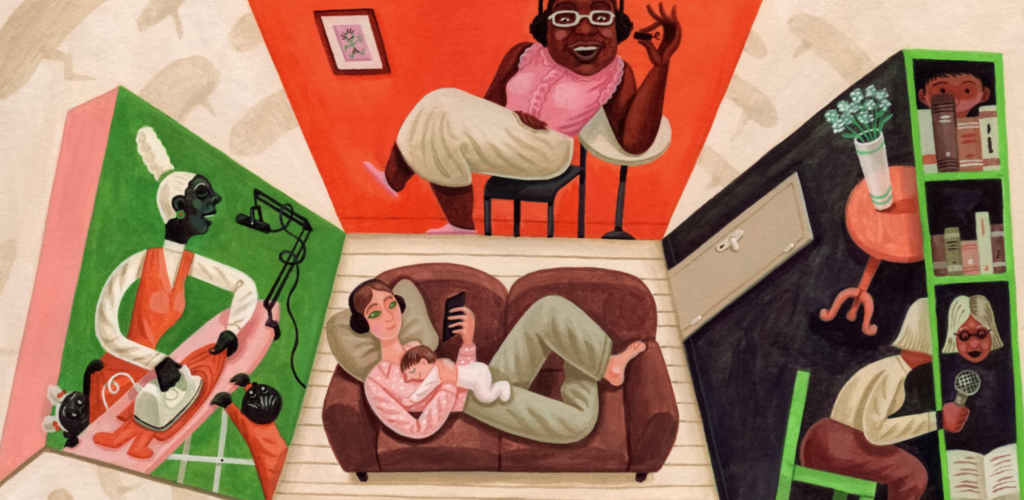
I rarely find myself in the spaces where parents confab with their cohorts. The leisurely, organic conversations that my parental predecessors used to enjoy at playgrounds, houses of worship, and school gymnasiums have been edged out by certain technologies. Events like PTA meetings, which are often used to facilitate the kind of end-of-days commiseration I crave, have largely moved online. And even when I do attend in-person events, instead of socializing on sports bleachers or in the music school lobby, everyone is often slouched over their phones.
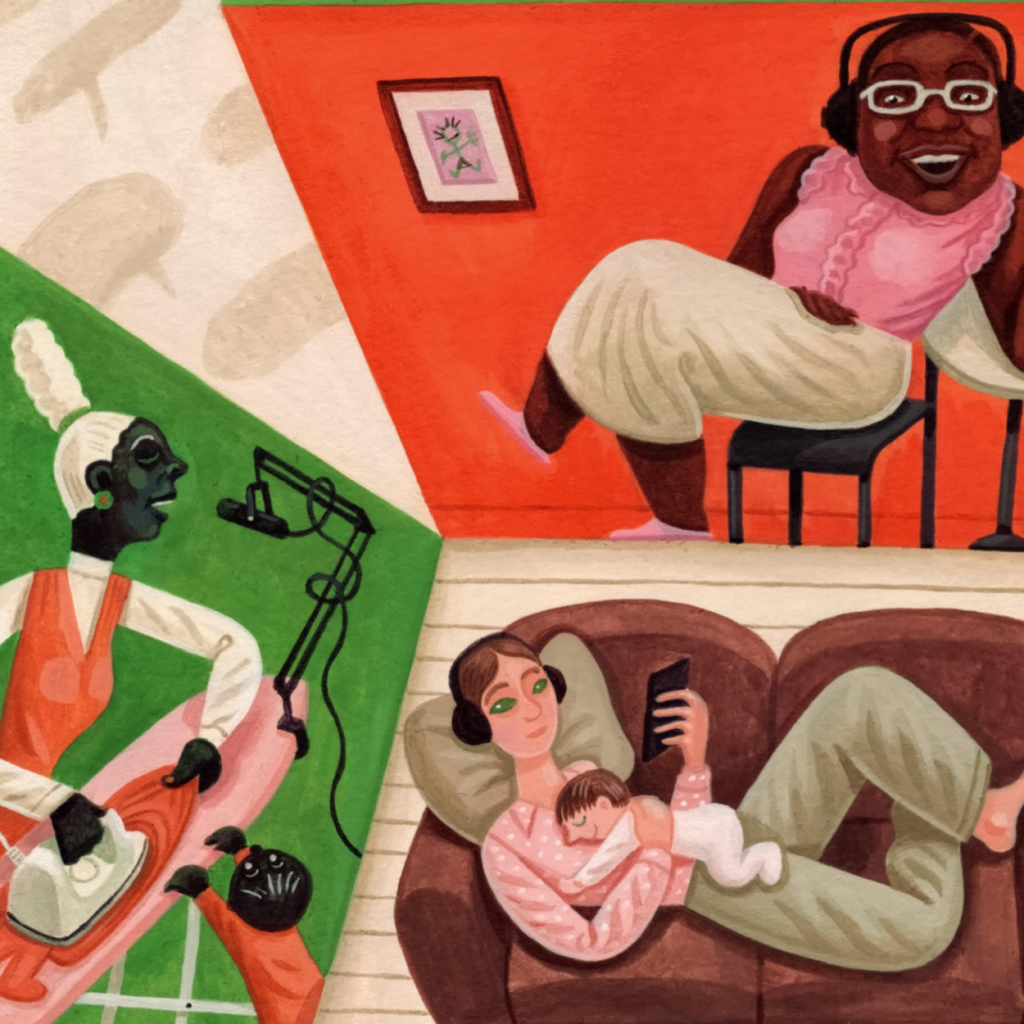
Enter the parenting podcast sphere, which fills the void left by the dearth of casual conversation. In a fragmented and frazzled society, these podcasts offer in-ear connections, giving voice to the many concerns parents encounter as they attempt to raise healthy kids in unstable political and environmental times.
“The Mother Of It All” podcast was born in 2023, when Miranda Rake and Sarah Wheeler, two writers and mothers who admired each other’s work, connected online. Their show departs from the clickbait headlines popular in media aimed at parents, and instead of manufacturing hot takes about controversial trends, they offer wide-ranging conversational meanderings and interviews with experts, authors, and influencers about complex topics that require nuance and in-depth discussion. The hosts’ calm delivery comforts their core audience, which, according to Rake, consists of millennial moms who are concerned about screen time, health care, climate change, racism, and trans rights. When the cohosts discuss their own parenting highs and lows, Wheeler often draws on her training as an educational psychologist, employing a therapy-speak qualifier — “I hear you saying” — to assure both her cohost and listeners that they’re not alone.
Similarly, “No One Told Us” host Rachael Shepard-Ohta, an influencer and mom, connects with her audience of mostly millennial moms by using a soothing tone and providing evidence-based information on topics such as sleep, nutrition, health care, relationships, and travel. Also podcasting since 2023, Shepard-Ohta considers the biggest threat to parents of young children to be information overload, so she aims for “reasonable, normal conversations, which is very unlike a lot of the big podcasts right now,” she said.
While podcasts such as “The Mother Of It All” and “No One Told Us” tackle a breadth of parenting topics, other shows focus on more specific concerns. “Taking Authority Over Autism,” for example, provides commute-length episodes with resources and services aimed toward helping parents who have children with special needs related to autism. Sheletta Brundidge, a media personality and mom, has been hosting the show, which she considers an audio toolkit for therapists, educators, and parents, since 2020. Generously sharing tips that have worked for her four children, three of whom have autism, Brundidge also draws listeners in with her casual, off-the-cuff delivery.
“[It’s] like we just bumped into each other at Costco,” she said. “Like, hey girl, you got a kid with autism? You need to hear somebody who’s been in your shoes, who loves you, who wants the best for you, who’s not trying to sell you something.”
Ultimately, though, Brundidge wants to podcast herself out of a job. “I want to do a podcast with enough information that parents don’t have to listen no more. I want to make sure that if they listen to my podcast, they are equipped with whatever it is they need to fight for their children,” she said.
Sometimes concerns double with a multiple birth, which is where podcasts like “Dad’s Guide to Twins” help parents problem-solve. Host Joe Rawlinson, who has been podcasting for over a decade, addresses myths, stereotypes, and preconceptions about twins while answering questions from the dads who submit them to his podcast, ranging from the serious (toddlers biting) to the silly (no, identical twins can’t share a passport). On a recent episode that addressed the fears of expectant twin fathers, Rawlinson counseled his fellow dads, reassuring them that as twin parents, they’ll quickly develop some coping strategies. “The basic rule of thumb is to handle the most pressing issue in the moment,” he said.
A great thing about this community is that if you grow out of one show, there’s any number of others available to meet you where you’re at. Dr. Lisa Damour, an author and clinical psychologist, knows that parents of adolescents need support, which is why she started “Ask Lisa: The Psychology of Raising Tweens & Teens” in 2020, when, as she put it, “the pandemic was uniquely awful for teenagers,” with her cohost, Reena Ninan, a journalist in Connecticut. Their listeners are mostly parents aged 35 to 55, and 30% of them are dads. “What’s beautiful about our format,” Damour said, “is that, because I have my ear to the ground, we can turn things around quickly.” The pair chooses episode topics based on listener letters and feedback regarding issues as they enter the zeitgeist. Damour is extremely proud of building an accessible mental health support resource for families. “Whatever your concern is,” she said, “there’s a very good chance we’ve addressed it at least once.”
There are as many parenting podcasts as there are parent worries. While those of us trying to raise kids these days have fewer opportunities for organic, in-person encounters, at least the parenting podcast sphere provides a one-way conversational substitute. When I see other parents in my orbit bedecked with earbuds or headphones, I assume they’re also tuning into voices that offer camaraderie and counsel about bike safety, vaccine availability, grade-level literacy, overbites, eczema, adolescent anxiety, or whatever threat emerges next. Maybe next time one of those parents takes the earbuds out, I’ll ask them what they’re listening to. And maybe, just maybe, we’ll bond in real life about our favorite anxiety-soothing parent podcasts.

Deborah Copperud is a writer, podcaster, and Community Education instructor in Minneapolis. She co-hosts the podcasts “It’s My Screen Time Too” and “Spock Talk.”