How Not To Waste Time
CUNY’s “How To Run an Indie Podcast” panel on November 12 promised a candid conversation about making the show of your dreams. And on that count, it delivered.
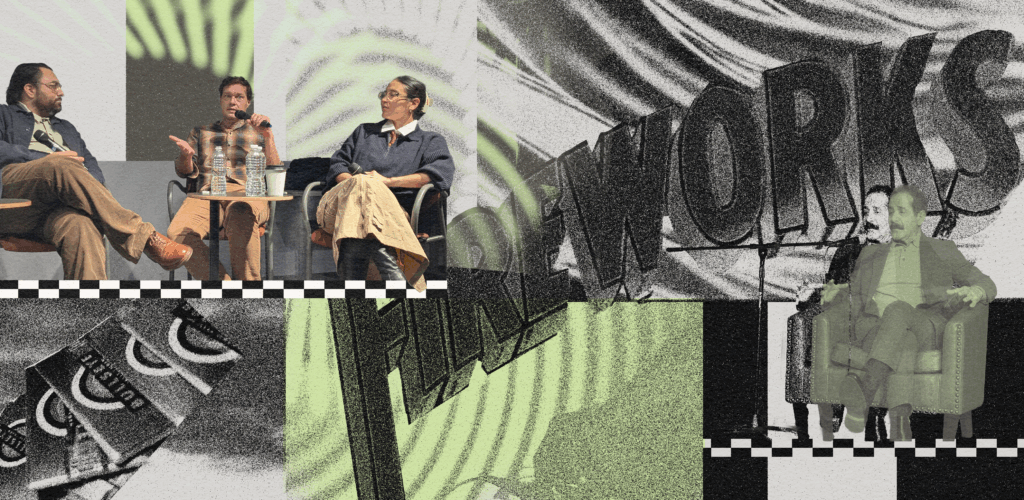
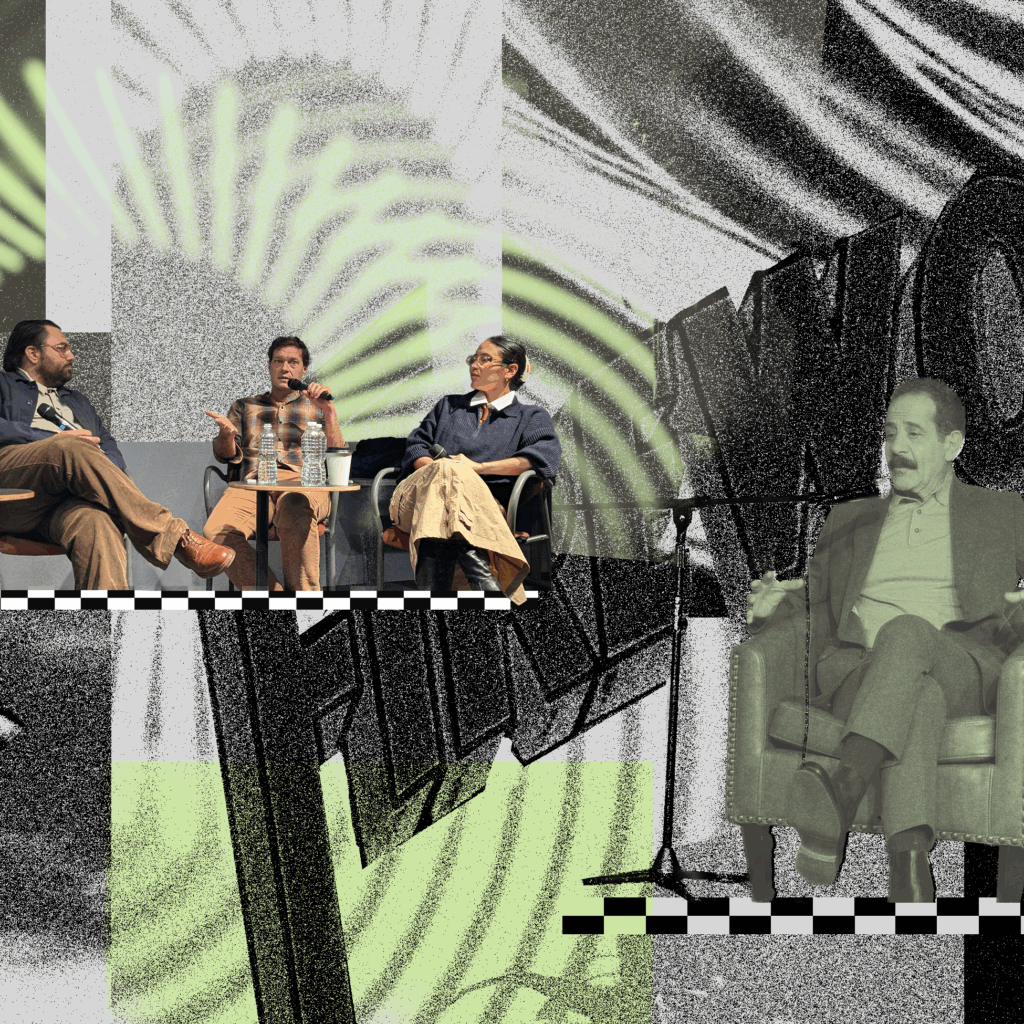
Brian Reed (“Question Everything”), Evan Ratliff (“Shell Game”), and Yowei Shaw (“Proxy with Yowei Shaw”) populated the stage at the Craig Newmark Graduate School of Journalism in NYC. The three luminaries of the independent podcasting space have collectively won two Independent Media Initiative prizes and a pile of Signal Awards, and have produced some of the most compelling narrative audio of the past decade with shows such as “S-Town” (Reed), “Longform” (Ratliff), and “Invisibilia” (Shaw) before striking out on their own.
But as Ratliff described the age-old battle between creative autonomy and financial stability, a philosophical standoff was brewing. “I have kids,” he said plainly. “I’ve taken all types of deals. I’ve given up ownership. I’ve not given up ownership. It’s always a trade-off.” And sometimes, he acknowledged, that puts you in a position where “you’re taking notes from people that you think are absolute bullshit” to get the money for a project of your own.
To illustrate this point, Newmark J-School moderator Kalli Anderson shared a pro tip she learned for handling notes from layers of executive editors. She suggested submitting your work “one draft behind,” meaning submitting it with “obvious errors” you’ve privately earmarked to fix on the next pass. This will give your superiors something to do, she winked, to justify their fancy titles. “Let them fix it, and then say, ‘Oh, great idea.’” As she spoke, a few mid-level producers in the house nodded in recognition.
That’s when Reed broke in, his voice pitched at the very fulcrum between disgust and horror.
“What a waste of fucking time,” he said.
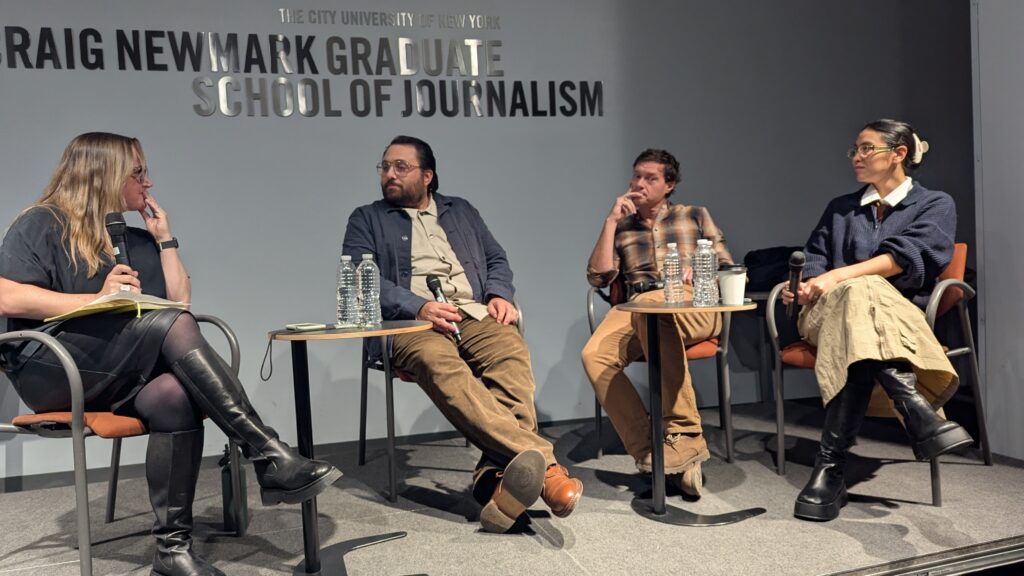
Reed was not attacking the moderator per se. But the idea of spending one’s wild and precious life on executive make-work was a premise he couldn’t seem to square. “You have so much else you can be doing with your time,” he said.
This brief skirmish, just 15 minutes into the hour-long evening, helped set the stakes for this discussion. The questions of how creators survive are not theoretical. They are real and urgent.
In indie podcasting, the question of time is often overshadowed by questions about money. How should you crowdfund? Should you be applying for grants? Should you pay yourself? How much should you pay everyone else? And the panelists shared some refreshingly granular insights on the financial front.
Shaw recalled that she started “Proxy” “out of necessity” after being laid off from NPR in 2023. (Season 1 begins with a trilogy of episodes about said layoffs.) “Luckily, we had very good severance due to our very good union contract,” Shaw said. Having a financial cushion gave her the runway to articulate and define her new reporting beat, which she describes as “emotional investigative journalism.” After that came a year of burning through her savings, supplementing her income with a part-time gig “making a spirituality show for one of the Kennedys,” building an active Patreon, and applying for grant after grant, until the financial picture for “Proxy” snapped into focus. When she was given a $50,000 IMI award in 2025, “I screamed so long and loud,” she said. “It meant that ‘Proxy’ is going to live.”
By contrast, Ratliff had not heard of the IMI award before learning he would be a recipient. “I got an email from someone that I didn’t know, that said, ‘This is not a trick. This is not spam.’ That was the subject line.” Since Ratliff’s “Shell Game” follows an AI clone of himself down some uncanny-valley tunnels, it really did take time for him to believe that the prize was real and not a cleverly targeted scam. But once it arrived, he says, the grant was the turning point in making “Shell Game” profitable.
“I paid for [Season 1] out of my pocket,” Ratliff said. “I’m a very strong believer that everyone involved in any project that I work on gets paid, or they have ownership.”
But more than finances, the topic of ownership surfaced most often throughout the evening. Indeed, it was the deciding factor in Reed’s decision to leave his enviable position with “Serial” after the show’s acquisition by The New York Times. “I just wanted to own what I make,” Reed said. “We pour so much of ourselves into this work. Just time, energy, skill, personal stories, opinions, thoughts, and ideas. And I just wanted to not have it owned by The New York Times.”
That isn’t to say that the panelists’ shows are unfettered by partnerships. “Proxy” is distributed by Radiotopia; “Shell Game” is now partnered with Kaleidoscope, and Reed’s “Question Everything” airs on the NPR affiliate station KCRW in Los Angeles, which provides the show’s budget. “We’re able to hire a staff. Fact Checkers, travel, legal,” he said. “It’s a smaller budget than I’m used to on my other shows. But it’s a real budget.” And, he pointed out, “if they were to stop doing it, we could take it and do it somewhere else.”
This, above all, gets to the molten core of the indie podcaster’s raison d’etre. Not “How do I get rich?” But “How do I keep making my show before someone makes me stop?” That’s all you’re really bargaining for: the runway to keep going.

A mere 11 blocks south and four days later, a different event perfectly embodied this irrepressible “keep going” spirit. “Bullseye with Jesse Thorn 25th Anniversary Live Spectacular!” enjoyed the final of three celebratory live podcast tapings at the People’s Improv Theater on Saturday, November 15.
The evening’s aesthetic was enticingly shambolic. The PIT main stage is a small, black box comedy venue featuring an ancient area rug and furniture so defiantly mismatched that it plays like a practical joke.
“I want you to know,” Thorn said, pointing to the black faux-velvet table cover enveloping his onstage ‘desk,’ “that underneath this is just, like, the most used-office-furniture-store table that you could possibly buy on Earth. And we have it covered with the cover from the piano.”
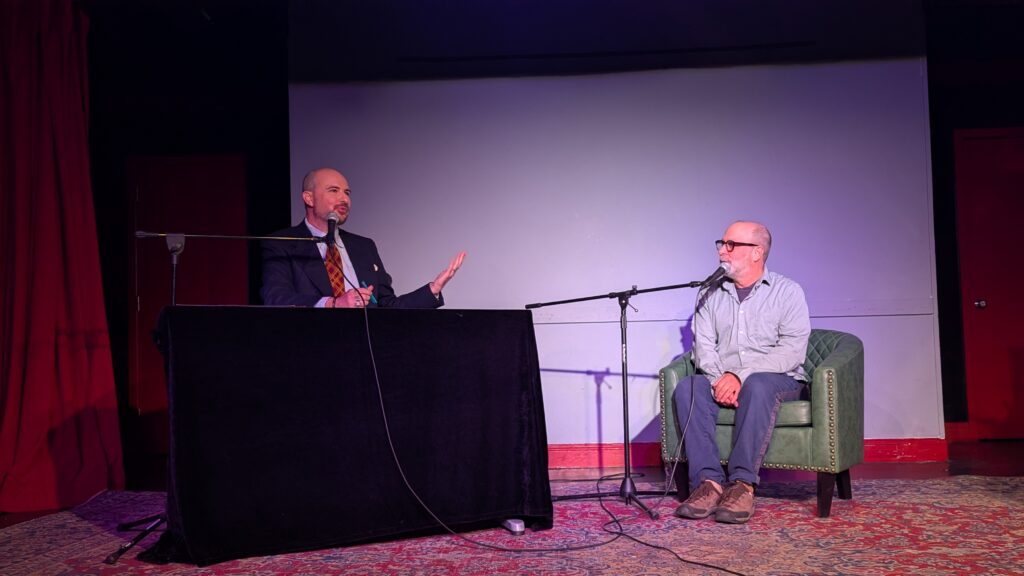
Throughout the night, Thorn and his senior producer, Kevin Ferguson, leaned into the DIY of it all, which is fitting for a show produced by the worker-owned co-op Maximum Fun. But the evening’s student-showcase vibe and casual approach to entrances and exits never felt unprofessional. Instead, it seemed an intentional part of Bullseye’s 25-year magic trick. “This is for radio, dumdum,” the oddball furniture practically whispered. “Don’t worry about the rug.”
Thorn in person is a stealthily polished host, quick with a riff or a Dustin Diamond anecdote to cover an onstage mic repair. But his signature talent, the thing that has kept “Bullseye” going — since Thorn was a 19-year-old UC Santa Cruz student, and the show was called “The Sound of Young America” — is his ability to quickly lock into his guests’ peculiar frequencies.
In terms of programming, the show was expertly stacked. Josh Gondelman did a breezy set on his war with a neighbor’s Ring camera. H. Jon Benjamin reflected on the similarities between “Bob’s Burgers” and heroin (complimentary). Tony Shalhoub revealed that there’s a surprising amount to say about bread. EGOT-havers Bobby Lopez and Kristen Anderson-Lopez performed not one, but two of their celebrated original songs. One was from “Frozen.” One was from an old Muppets project that never actually got greenlit.
And in a segment so audiophilic it was effectively podcaster fan service, Jad Abumrad discussed the making of his new limited series, “Fela Kuti: Fear No Man.” He also opened up about creating, and then stepping away from, “Radiolab,” a wildly successful show he started in 2002.
“You really did cocreate and host one of the most important radio shows ever,” Thorn began. “So how did you decide to do that? And what was it like to leave?”
The question was so direct, Abumrad cracked a joke to buy himself some time. But his eventual answer recalled themes raised at that Newmark J-School panel the previous Wednesday.
“Initially, it was the thing that I made with my own hands,” Abumrad began. “From the reporting and choosing the stories to the editing to the scoring.”
“But then,” he continued, “we got resources to hire people. Suddenly, there are 30 people working at the show. And they became really talented and amazing, and so I had to make space for them. And I went from being the guy who makes the thing, to being the guy who holds the space for others to make the thing. Which I think is the natural cycle of so many things, right?”
Abumrad went on, “But at a certain point, I kind of just want to make stuff.” Which, in the end, is usually what most of us are chasing.
Thorn ended the show with a monologue we won’t spoil here, except to share that it was on the subject of time. Time as a gift, time as a curse, time as an hour to be filled.
Making anything takes time, from the most soulless advertorial chat show to your life’s most important work. Why would you ever choose to waste it, except out of fear? And once you let go of that fear, what could possibly stop you?

Katie Clark Gray is a Webby award-winning podcast producer, Pew Fellow, and partner at Uncompromised Creative. Past credits include: writer/producer, “The Best Idea Yet” (Wondery); senior producer, “Masters of Scale” (WaitWhat); writer/performer, “Fathom.” More at Uncomp.ninja.