Katie Clark Gray is a Webby award-winning podcast producer, Pew Fellow, and partner at Uncompromised Creative. Currently she writes for Audible Originals’ “Scamfluencers” and “Business Wars.” Past credits include: “The Best Idea Yet,” “Masters of Scale,” “Spark & Fire,” “Meditative Story,” and feature film “The Paper Store.”
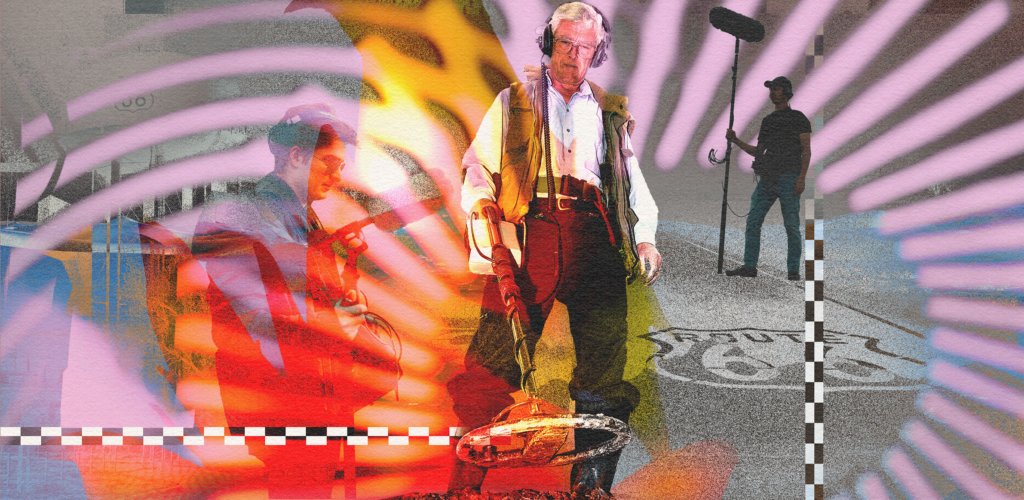
The Fate of Route 66
The 30th annual Webby Awards will be held next week on Monday, May 11. Three decades is a serious milestone, and these awards, which celebrate the digital cutting edge, are officially older than TikTok, Instagram, the iPhone, YouTube, Facebook, Google, and podcasting itself.
A glance through the Webbys’ inaugural 1997 winners puts this into focus, whisking you back to a time when the nominees were all actual websites. One, for example, was dedicated to exploring historic Route 66, with the tagline, “Where the Mother Road meets the Information Superhighway.”
Since then, the Webbys have worked to keep pace with the ever-broadening expectation of what it means to Be Online. The International Academy of Digital Arts & Sciences, the Webbys’ adjudicating organization, now recognizes many more flavors of Internet Product, including social media channels, short-form video, brand partnerships, and AI-enabled devices. Did you know that the inanimate products Claude Code and the Oura ring are taking home Webbys this year? Or that, specifically, Claude has been named the Webby’s Person of the Year?
As for the mortal human winners, they range from the most celebrated IRL icons (Kendrick Lamar, Lady Gaga, Lionel Messi) to the most internet-notorious (the Rizzler, the Try Guys), whose road to success is paved with relentless algorithmic optimization.
It’s all very chaotic. But it’s also an honest reflection of the world as it is. For your project to thrive both critically and monetarily, you have to be either very famous already or exceptional at moving the robots’ unseen hand. And to do the latter, you need to try some stuff.
“Trying stuff” used to be podcasting’s specialty. An art form that originally needed very little overhead and very few rules had room to experiment. The audience engagement playbooks were not yet written, so you could have shows as varied in voice and format as “Love + Radio,” “Welcome to Night Vale,” “WTF,” “The Read,” “Reply All,” “Millennial,” and numerous other shows now considered part of the medium’s canon.
Peruse the bold-faced names featured among this year’s Webby-winning podcasting cohort, and a different story emerges. You’ll see Jason Bateman, Will Arnett, and Sean Hayes; Amy Poehler; the Kelce Brothers; and Don Lemon — all people who were already very famous before plugging in their mics — hosting. While they aren’t the only podcasters to take home that little coily trophy (some of you reading this are winners as well; mazel tov!), you can learn a lot about a club from its headliners.
And right now, the awarding bodies celebrating these headliners and the networks promoting them across social platforms are playing it extremely safe. Putting aside the whole right-wing, nativist cesspool side of podcasting (which is still, regrettably, thriving), the remaining field is awash with generally charming and funny TV people, doing TV-style talk shows on a small screen. These tiny talk shows are often consumed out of order in short clips, one minute at a time. They are enjoyable, they are pleasant, and they risk almost nothing.
In this existential moment, too many podcast teams and execs seem content to follow the leader. “If it works on ‘Good Hang,’ it’ll work for [show name here].” Meanwhile, elsewhere in the creator space, the conversation has already moved on to whether the clipping bubble is ready to pop. It’s possible that the entire pivot-to-short-form gambit will implode the moment your podcast team finally gets good at it. (And that’s before we even talk about the encroachment of AI podslop, a problem so glaring it needs a whole separate newsletter entry to address it.)
The World Wide Web used to be one discrete arm of one’s media strategy. Now, it is the open maw of a ravenous beast called ‘discoverability,’ and we are all doomed to keep chucking red meat down its gullet if we want anyone to support our work. It doesn’t feel sustainable — because it isn’t. This is not enough to keep our industry alive. This is not enough to feast. And this is going to be a problem for all of us.
With this in mind, it feels incumbent upon the entire podcast industry, from the talent to the executive leadership, to innovate our way out of this dead end. Where will the next big idea in podcasting come from? And who will lead the charge?
This question is not rhetorical. It demands an answer. Someone must blaze a new trail out of our content oubliette. Maybe it’s several someones. But if no one rises to the challenge, we will fall into gentle disuse, like a charming truck stop along a discontinued highway.
The Beige Place
Khloé Kardashian’s video podcast aesthetic is a visual lobotomy.
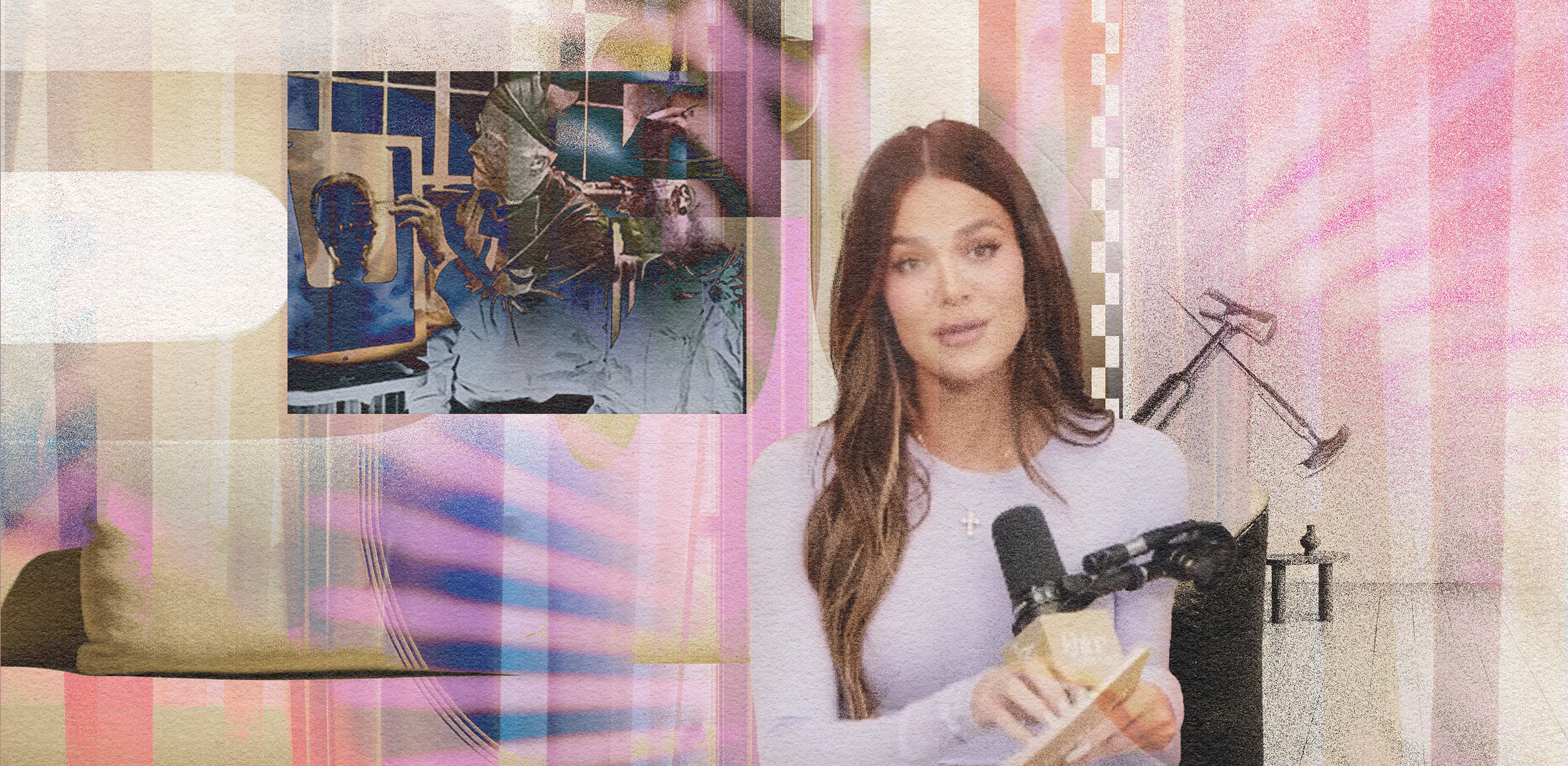
Words by Katie Clark Gray
Art by Sami Wittwer
The first lobotomies were performed in 1935.
Two American neuroscientists removed brain tissue from the frontal lobes of chimpanzees, noting that one of the primates became less agitated following the procedure. That same year, a Portuguese surgeon performed the world’s first lobotomy on a human. He would later receive the Nobel Prize.
This experimental surgery was said to reduce aggression, disorientation, and even violence in severely mentally ill patients. It was, of course, a frightening prospect to have someone drill a quarter-sized hole in one’s skull, insert a tiny wire, and sever the connection between one’s prefrontal cortex and the rest of one’s brain. Even in the early 20th century, doctors recognized the frontal lobe’s importance in accessing imagination, discernment, and self-esteem. But severing these essential aspects of personality was considered a small price for pacifying the unpacifiable. Some 50,000 people were given lobotomies between 1949 and 1952 alone.

Some other stories that have our attention, brought to you by Good Tape’s “Off The Record” — an event series creating real-time dialogues between podcast executives, creatives, and brands on hyper-relevant topics to evolve the medium.
- • The Transom Story Lab is celebrating its 25th anniversary with the Transom 25 festival from Thursday, Sept. 17 through Saturday, Sept. 19 in Woods Hole, Massachusetts. The program will include a headliner talk with Ira Glass and Tobin Low, as well as featured speakers Nichole Hill and Al Letson. Tickets here.
- • The annual AIR Gala is on Thursday, May 28 at DCTV in New York City. Free for members; $45 for non-members. (But really, you should become a member.)
- • Big news from the creator world: Patreon announced it is expanding access to its discovery feed. With social media fracturing and discoverability facing all the challenges we mentioned above, this seems like a smart next step for one of the few platforms that’s consistently growing podcaster revenue in the 2020s.
- • Reminder: Pitch us! Submissions are open for our fourth print issue until May 15 at 5:00 p.m. ET. To answer any questions, we’re hosting a live Q&A session on Wednesday, May 13 at 1:00 p.m. ET / 10:00 a.m. PT. Join our editors to talk about what we’re looking for, and what YOU want more and less of from Good Tape this year and beyond.

Good Tape is proudly independent yet deeply rooted in community. If you value our work exploring the ideas, people, and forces shaping podcasting, share this newsletter with a friend. Or, better yet, become a subscriber. Your support helps sustain our commitment to elevating cultural and critical coverage of the podcast industry.
Katie Clark Gray is a Webby award-winning podcast producer, Pew Fellow, and partner at Uncompromised Creative. Currently she writes for Audible Originals’ “Scamfluencers” and “Business Wars.” Past credits include: “The Best Idea Yet,” “Masters of Scale,” “Spark & Fire,” “Meditative Story,” and feature film “The Paper Store.”