Katie Clark Gray is a Webby award-winning podcast producer, Pew Fellow, and partner at Uncompromised Creative. Past credits include: writer/producer, “The Best Idea Yet” (Wondery); senior producer, “Masters of Scale” (WaitWhat); writer/performer, “Fathom.” More at Uncomp.ninja.

Of Cameras and Cults
Welcome back to the work week! To our readers coming off the Thanksgiving holiday, we hope the reacclimation process has been gentle. (It’s such a bittersweet moment, turning off that OOO responder.) For those who don’t observe, we’re glad you survived your friends’ live-posting through the Macy’s Thanksgiving Day Parade.
Speaking of time off, Good Tape HQ will be going dark from December 22 to January 2 for the winter holidays. But never fear, there’s still one more newsletter coming before we say goodbye to 2025. Look for it in your inbox one fortnight hence.
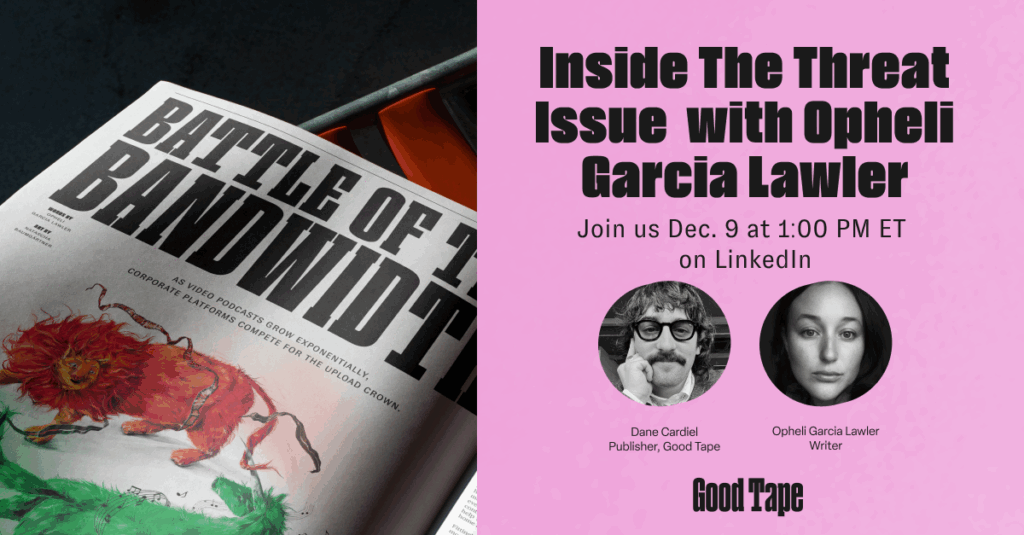
In the meantime, we’ve got news. We’ve just released digital versions of two pieces from The Threat Issue. “State of the Union” examines institutional backlash to podcasting’s labor push, and where organizers stand today. And “Battle of the Bandwidth” dives into the intercorporate struggle for dominance in the video podcasting era. Now that the cameras are rolling on creators, will Spotify or YouTube emerge as the video podcast platform of choice? And where does that leave audio-first shows?
Both features are by prolific freelance reporter Opheli Garcia Lawler, who will do a live Q&A with Good Tape’s own Dane Cardiel next week. It will be a great convo. You can RSVP here on LinkedIn.
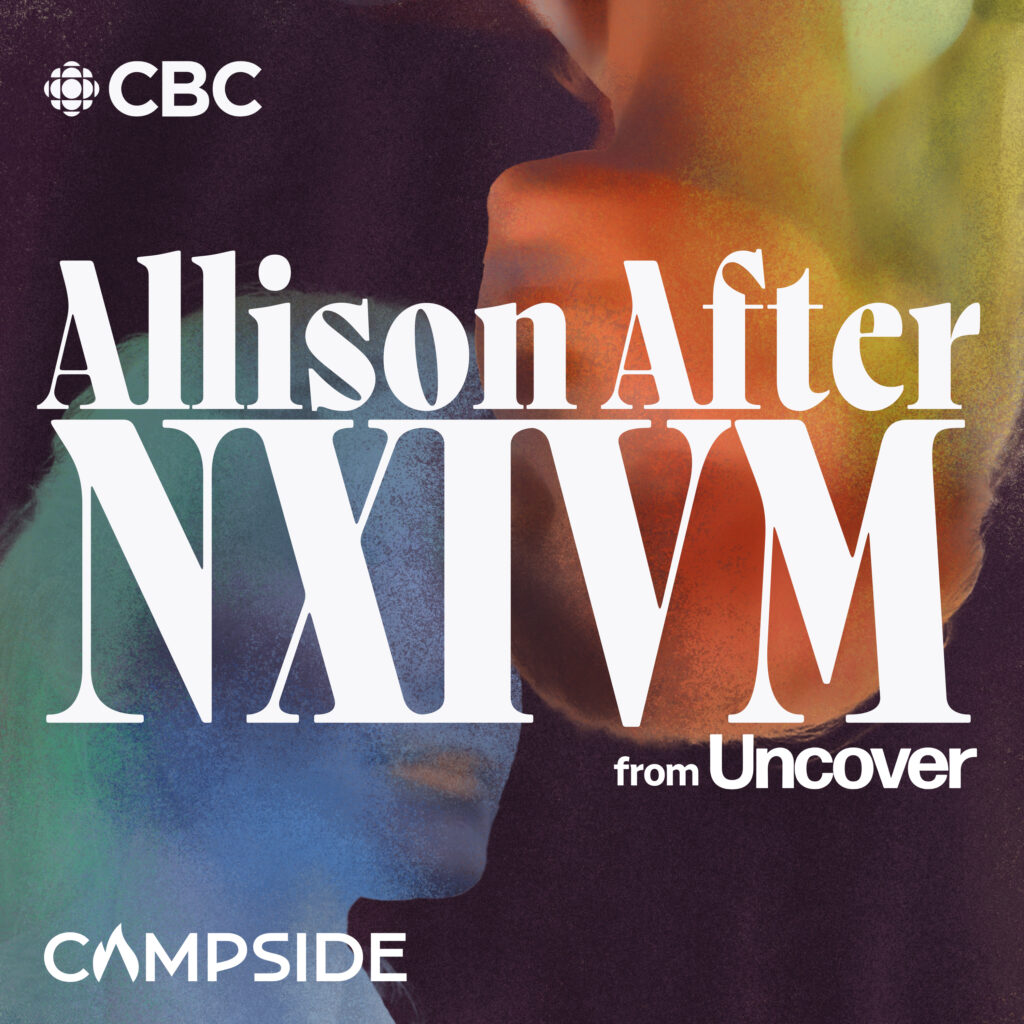
Finally, read to the end for a reflection on CBC’s latest “Uncover” limited series, “Allison After NXIVM.” For those who can’t resist a good cult story (guilty), the series doesn’t disappoint. And we’re not just saying that because our own Sami Wittwer at Good Tape Studio did the artwork. But it will make you think hard about the tricky line between objectivity and empathy, and the challenges of anchoring a show to a charismatic criminal.
– Katie Clark Gray for Good Tape
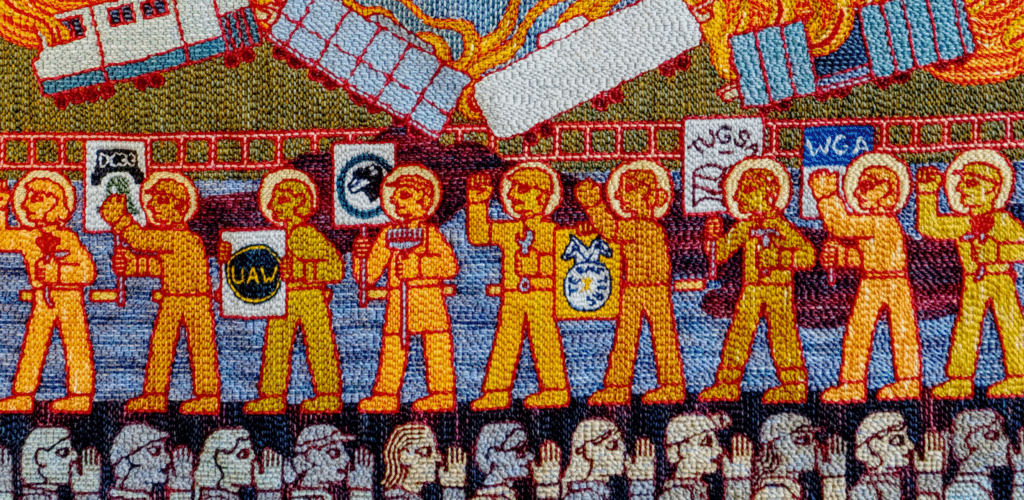
State of the Union
Despite skeptics calling the organizing push fruitless, labor leaders forge ahead.
One of the most anxiety-inducing days of Meg Driscoll’s life was when Gimlet management discovered the staff was unionizing. Until that day, the union drive had been a secret, and the 10-person organizing committee was incredibly committed to keeping it that way.
Meetings were held off-site after work, and extreme caution was taken to keep them confidential. “We were all leaving the office and walking in separate directions,” Driscoll said. For months, the committee met to determine potential members and pressing issues. “That, for me, was when it was extremely nerve-wracking, and you could feel the thing getting bigger and more difficult to manage, and taking up more of our time,” Driscoll said. After much consideration, they prepared to petition the National Labor Relations Board (NLRB) for a unionization vote.
But before they were ready, one day in early 2019, management asked about the union, a word that, before that conversation, no one had dared utter at the office. It turned out that Spotify was in the process of purchasing Gimlet, and a union could complicate the sale. Driscoll and the rest of the organizing committee rushed into action in an effort to prevent any potential union-busting activity.
“We descended upon our coworker’s apartment, where we used to meet,” Driscoll said. Within an hour, union members took the first step in petitioning the NLRB by collecting signed authorization cards, which indicated that employees wished to be represented by the union for the purpose of collective bargaining.
What happened next was no easy path to victory. Still, it inspired other podcast companies to fight for recognition and secure first contracts, establishing a baseline for wages, benefits, and working conditions. Within a few years, unions sprang up at Pineapple Street Studios, Parcast, Crooked, iHeartRadio, Pushkin, and The Ringer. Sophie Bridges, who started working at Pineapple Street Studios as an intern in 2019 and later became a producer, began organizing with a few coworkers after the Gimlet staff union went public.
“The Gimlet unionization effort was something that I had followed, probably even before I had a job in podcasting,” Bridges said. “It was so cool to see people sticking up for themselves and also putting forward this vision of what working in this industry should look like.”
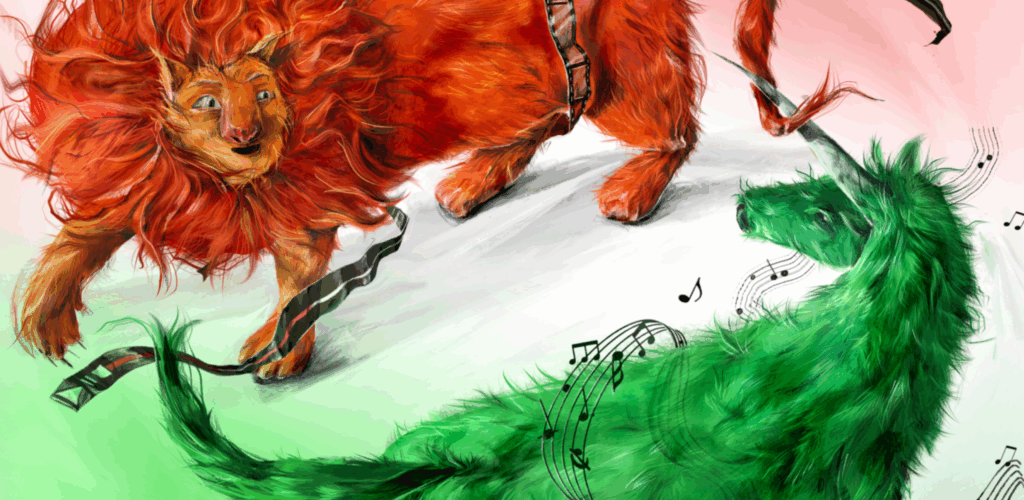
Battle of the Bandwidth
As video podcasts grow exponentially, corporate platforms compete for the upload crown.
There’s a marked hunger for audio content right now. According to “The Podcast Consumer 2025,” an Edison Research report on the industry published earlier this year, the number of hours Americans spend listening to podcasts increased by 355% over the last decade. Put differently, Americans now collectively listen to 773 million hours of podcasts each week, which is tantamount to every single American over 13 years old listening to approximately 20 minutes of podcasts a day. The seemingly endless demand for something to engage with or dissociate to while cleaning, working, commuting, and so on accounts for the medium’s uninhibited growth.
Major corporations, of course, have taken notice. Most notably, Spotify has leveraged its position as a top music streaming platform in an attempt to corner the podcast market as well. Recognizing an opportunity to maximize its influence by not only hosting but also producing podcasts, the company quickly acquired smaller studios and lured in big names with $100 million contracts. These aggressive acquisitions helped cement Spotify as the most listened-to streaming platform in the world. But when it comes to podcasts specifically, Spotify has captured only 26% of American podcast listeners compared to YouTube’s 33%, according to Edison Research’s annual “The Infinite Dial” report. And despite being an early adopter, supporting the medium since 2005, Apple Podcast’s current audience share is just 14%, according to that same report.
The relative success of these platforms in the market is not solely due to acquisition budgets or historical support; it is also the result of an audio-based art form overwhelmingly becoming a video-based one. While video is not a new facet of podcasting (as far back as 2008, Apple Podcasts, then known simply as iTunes, supported the delivery of video over RSS), only now is the number of reported viewership growing. In 2025, 51% of Americans said they watched at least one podcast.
Gabriel Soto, the senior director of research at Edison Research, confirmed that the increase in video podcast consumption has been supporting YouTube’s growth quarter over quarter as the years go by, adding that among new podcast listeners, YouTube is also the preferred platform. “We can look at those who started listening within the last year to see what type of behaviors or what type of impact they might have on the future of podcast consumption,” Soto said. “We’re seeing that YouTube is the number-one service among First-Years.”
The most significant advantage YouTube has, of course, is that its infrastructure was built for video consumption from the start, allowing it to support video content creators with ease. Hot on the heels of YouTube, Spotify, and Apple, however, is short-form social media content. In early 2024, thanks to social media clips, Shannon Sharpe’s “Club Shay Shay” interview with Katt Williams was such a cultural moment that it was parodied on “Saturday Night Live.” Where earlier podcast discovery mechanisms like audiograms largely failed, video clips of podcasts on social media have broken through the noise and gone organically viral. It seems like podcasting has finally cracked its discovery problem.

If you’re in NYC next Monday, December 8, the AudioSpice Collective invites you to join them for a conversation on… deep breath… video podcasting. Whether you’re a convert to the cameras-on club or a die-hard audio-first creator, come for a “collective cathartic Session” on podcasting’s video pivot. The talk will feature Jess Fenton of the Wall Street Journal, Graham Litten of YouTube’s Podcast Partnerships team, and independent filmmaker and audio producer Andrew Callaway. Anonymous sharing allowed. You can RSVP here!
Cults and Culpability
Like many true-crime fans and narrative junkies, we’ve been scarfing down episodes of “Allison After NXIVM,” the limited series from Campside Media and CBC’s “Uncover.” Those familiar with the hit HBO documentary series “The Vow” and/or the arguably more interesting “Seduced: Inside the NXIVM Cult” from Starz will already be well-versed in the story of Keith Raniere, a textbook Mediocre Man™ who founded the NXIVM cult and, within it, an insidious sex-trafficking ring. But “Allison After NXIVM” serves as an important next entry into the saga because it features exclusive interviews with NXIVM’s most infamous member, the disgraced actor Allison Mack.
In 2019, before Mack pled guilty to charges of racketeering and racketeering conspiracy, she was known as the TV actor who played Clark Kent’s bestie on “Smallville.” But following Mack’s conviction and three-year prison sentence — less than two of which she ended up serving — the new TL;DR is that Mack spent years as a pitiless recruiter and enforcer for Raniere’s cult. Her crimes included introducing at least four women into a so-called “sorority” that enslaved and subjected them to horrific physical, mental, and sexual abuse.
At the start of “Allison After NXIVM,” host and producer Natalie Robehmed expresses deep ambivalence toward handing Mack a platform. So does fellow producer and Campside Media cofounder Vanessa Grigoriadis, whom Mack first approached to help tell her story. (In a complicated win for audio-first storytelling, Mack apparently turned down multiple television offers in favor of the audio podcast format.)
Robehmed and company revisit these doubts throughout the series, calling out moments in which Allison seems especially defensive or in denial. The producers work to fact-check Mack’s accounts where possible. And when the story feels like it’s drifting too far into Mack’s sole POV, you can almost hear the producers yanking the narrative steering wheel toward a more objective framing.
Mack is not the sole interview subject of the series, however. Among others, the producers also speak to Lauren Salzman, the former NXIVM member who turned against Raniere, and whose testimony helped put him in federal prison. Salzman’s perspective provides a welcome foil to Mack’s, and breathes a little space between the listener and the show’s chief subject.
But what’s unavoidable — and what no host tracking lines can fully solve — is that Mack is a frustratingly empathetic storyteller. Having been steeped for decades in a cult that framed trauma as self-help, Mack comes off as startlingly articulate about the abuse she both suffered and inflicted. She toggles between bemused observer and traumatized victim, recounting with dispassionate clarity the 500-calorie diet Raniere kept her on for years, then expressing shock at herself for sending a “sorority sister” to be assaulted.
One question that haunts “Allison After NXIVM,” which, at the time of this writing, has released five of its seven episodes, is how much remorse is Allison actually capable of? Because in her accounting, her crimes were less a choice than an inevitable product of her own (absolutely real) victimization. Nothing bad she did would have happened had Raniere not first mentally destroyed her. His sinking his claws into her is the catalyst for her own crimes. Once that first domino fell, how could she have behaved any other way?
This implicit framing by Mack sits uneasily next to the reality that, of course, she did have a choice, as Salzman’s actions prove. “Just following orders” famously doesn’t hold up in court. And so far, “Allison After NXIVM” challenges its listeners to remember this truth even if its star interviewee might prefer you forget.

Katie Clark Gray is a Webby award-winning podcast producer, Pew Fellow, and partner at Uncompromised Creative. Past credits include: writer/producer, “The Best Idea Yet” (Wondery); senior producer, “Masters of Scale” (WaitWhat); writer/performer, “Fathom.” More at Uncomp.ninja.