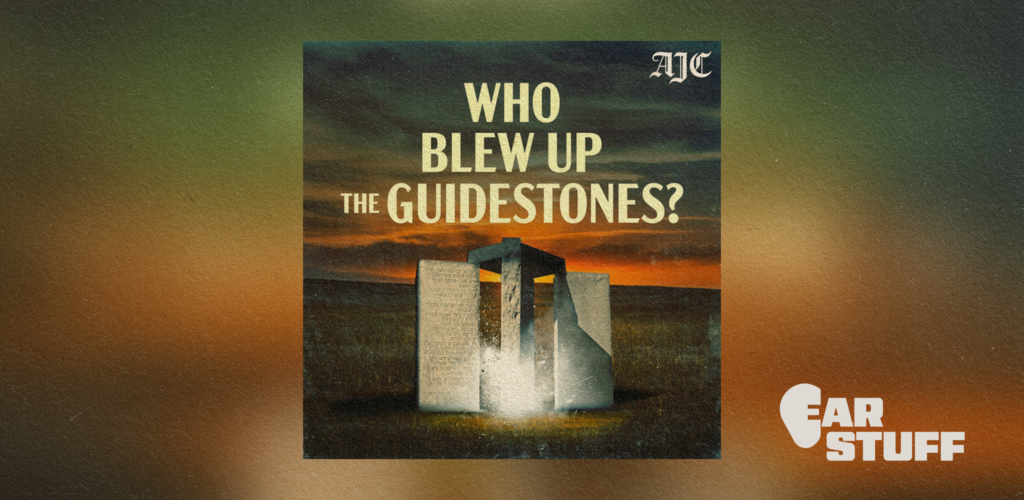
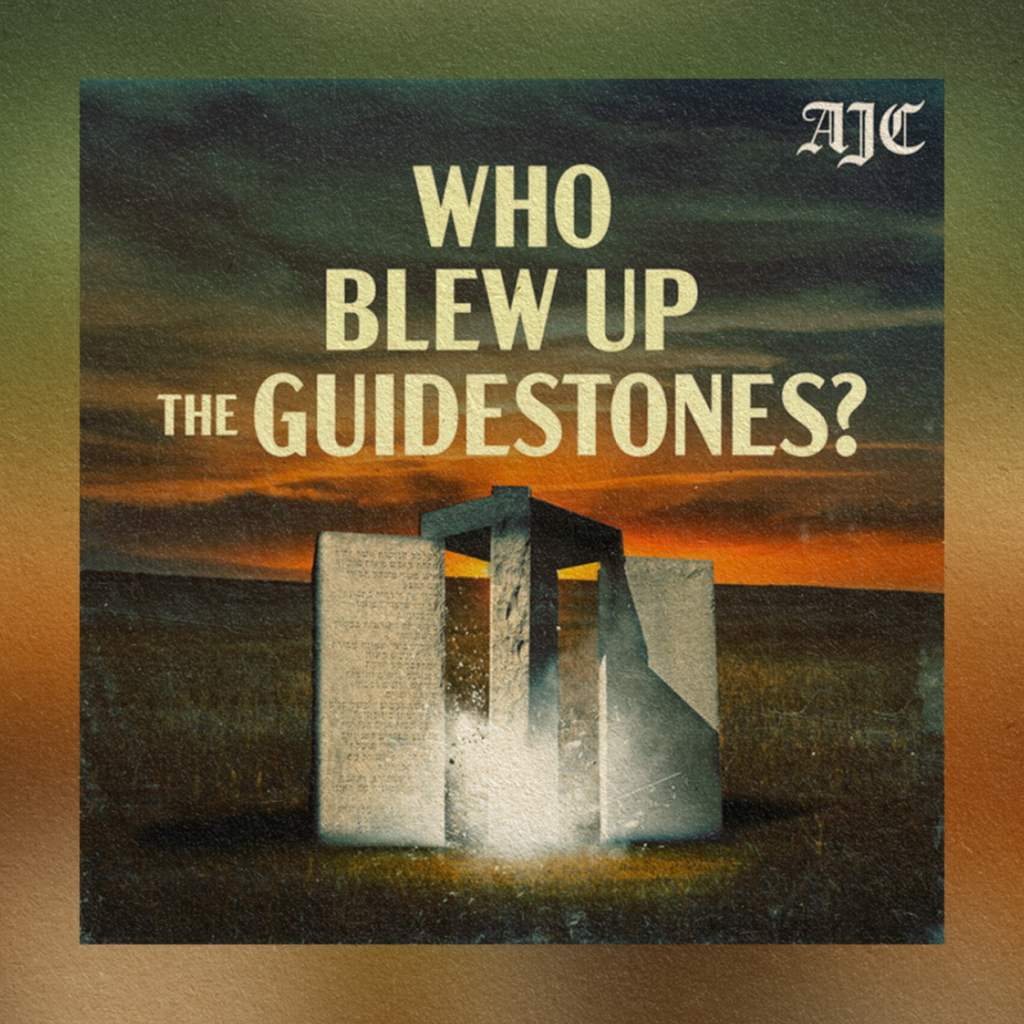
“Who Blew Up The Guidestones?”
“What are you trying to get at?” a man on the phone demands. “What is your goal?”
He’s speaking to — berating, really — reporter Tyler McBrien of the Atlanta Journal-Constitution. McBrien’s response is as gentle as his subject is combative. “Like I said, it’s just to get to the bottom of who blew up the Guidestones.”
This fascinating, frustrating exchange happens late in McBrien’s seven-part series, “Who Blew Up the Guidestones?” By this point, listeners will be familiar with the question, as McBrien repeats it dozens of times while talking to law enforcement or swapping theories with locals. Sometimes he invokes it as a rhetorical aside, a naked plea for the truth to appear.
In a sense, the podcast’s premise is extremely simple. On July 6, 2022, in Elberton, Georgia, someone destroyed a massive stone monument that had been standing since 1980. Occasionally dubbed “America’s Stonehenge,” the monument was made of great granite slabs covered in mostly hand-tooled writing translated into eight languages. Over the Guidestones’ relatively short lifespan, they attracted devoted visitors, often of the gothy, witchy variety, as well as vocal opponents, often of the Bible-thumping variety.
Then, one day, there was an explosion — and the Guidestones were gone.
The ensuing investigation by law enforcement is best described as unhurried. McBrien postulates that perhaps this was because the incident resulted in no actual casualties. The lack of interest from the police and a lack of suspects left room for conspiracy theories to flourish. But it also allowed McBrien and company to investigate the matter mostly undisturbed, conceivably positioned to uncover not just the who, but also the why.
Bucking the “I dunno” doctrine
Longtime fans of narrative true crime are no strangers to uncertainty. The floridly inconclusive end of the first season of “Serial” helped set this precedent, mostly out of necessity. Host Sarah Koenig and her team never did get to the bottom of whether Adnan Syed murdered his girlfriend. And yet, they had a series to resolve.
Koenig, to her credit, shared much of her hand-wringing on-mic, voicing concerns that she had let the audience down with a non-ending. Her musings, though, spawned a popular podcast template. Call it the “I dunno” doctrine. “We may never know who the killer is,” the doctrine teases, “But aren’t you glad we explored it together?” It’s a framework that constantly reminds listeners that the journey is the destination. To expect more is considered small-minded, even gauche.
The “I dunno” doctrine has become so pervasive in podcasting that it can be genuinely surprising when a series shows up with receipts. In that sense, “Who Blew Up The Guidestones?” has welcome surprises at every turn. McBrien and his producing team — which includes staffers from the AJC and Goat Rodeo — dig in, gumshoe-style, to find clues missed by both Elbert County law enforcement and the resplendently lackadaisical Georgia Bureau of Investigation.
In fact, much of the drama in “Guidestones” comes down to whether anyone with more authority will stop McBrien et al. from asking questions. It seems inevitable that someone will shut this whole thing down, and yet the reporters keep landing on hard evidence that gets closer and closer to provable truth.
In episode five, “Jesus, Guns, and Babies,” McBrien says that investigations “are about shrinking the known universe.” “When we started, we were looking for anyone in the world with a motive against the Guidestones.” After months of digging, the team manages to focus its spotlight with increasing precision. Suffice to say, the search yields, if not perfectly definitive results, a conclusion reminiscent of David Fincher’s “Zodiac” in both tone and substance. Certain mysteries, for legal reasons, can’t be declared solved, but listeners still leave feeling like they know what’s up.
A light touch gets good tape
“Guidestones” is a hyper-local story, steeped in syrupy drawls and small-town lore, and it takes its time giving the listener a sense of place. We learn all about the history of granite mining in Elberton, outsider folk art, and a chapter of the 2022 Republican primary for governor that even Georgia residents may not recall. One fairly long scene takes place in a Zaxby’s, complete with crinkling chicken sandwich wrappers. (Those who listen to their podcasts at 1.25x speed might find themselves bumping to 1.5x.)
Critically, the show never takes a condescending view of its subjects, even when they share viewpoints with questionable logic or morals. As the show reveals early on, the creation of the Guidestones was fraught with dark intentions, inspiring inaccurate yet equally dark theories. Talk of demons and lizard people abounds; Satan and QAnon get plenty of airtime. Throughout, McBrien treats guarded and/or disturbed subjects with a light touch, letting listeners draw their own conclusions. (His unassuming approach also, of course, helps keep the tape rolling.) In a genre known for swimming in exploitative waters, “Guidestones” comes across as both curious and respectful.
That said, “Who Blew Up The Guidestones?” does present one firm takeaway: To be human is to resist plain facts when they don’t support our worldview. Throughout the series, McBrien captures moments in which someone, confronted with hard evidence, rejects it out of hand. Why learn where the Guidestones came from when you could spin tales about Satan? Why reduce their destruction to one of simple criminal trespass, when you could point to the hand of the Divine?
The sheer investigative chops of “Guidestones” make it worth a listen, but its most profound takeaway is also the ultimate ironic twist. A band of journalists managed to pierce the heart of an enduring local mystery, only to discover that many people prefer the mystery to the truth.
![]()
Ear Stuff is made possible through the support of Goat Rodeo, an award-winning audio studio known for ambitious, creative podcasting. Goat Rodeo had no editorial input into this review.
Katie Clark Gray is a Webby award-winning podcast producer, Pew Fellow, and partner at Uncompromised Creative. Past credits include: writer/producer, “The Best Idea Yet” (Wondery); senior producer, “Masters of Scale” (WaitWhat); writer/performer, “Fathom.” More at Uncomp.ninja.